How World Samma Events Are Scored, Published, and Protected from Fixing
Audience note: This is the operational document for event organizers, results managers, division leads, and anyone holding scoring authority at a World Samma event. It is also the document a competitor can read and hold us to.
Every Samma event is, mechanically, a simple machine: tickets in, participants on a list, pairings drawn, scores entered, podiums stamped, prizes released, results published once and never touched again.
The machine is easy. The machine is trustworthy is the hard part. That is what this document is about.
Because the moment a competition has prizes, qualification slots, and a public leaderboard, it has an incentive surface. And the sport's answer is not "we trust our people." The sport's answer is a process that is hard to bend even if someone inside wants to.
Here is how it already works.
1. The Chain of Custody Starts Before the First Bell
An event is not trustworthy because of its results. It is trustworthy because of its inputs.
Registration is auditable from the moment of payment
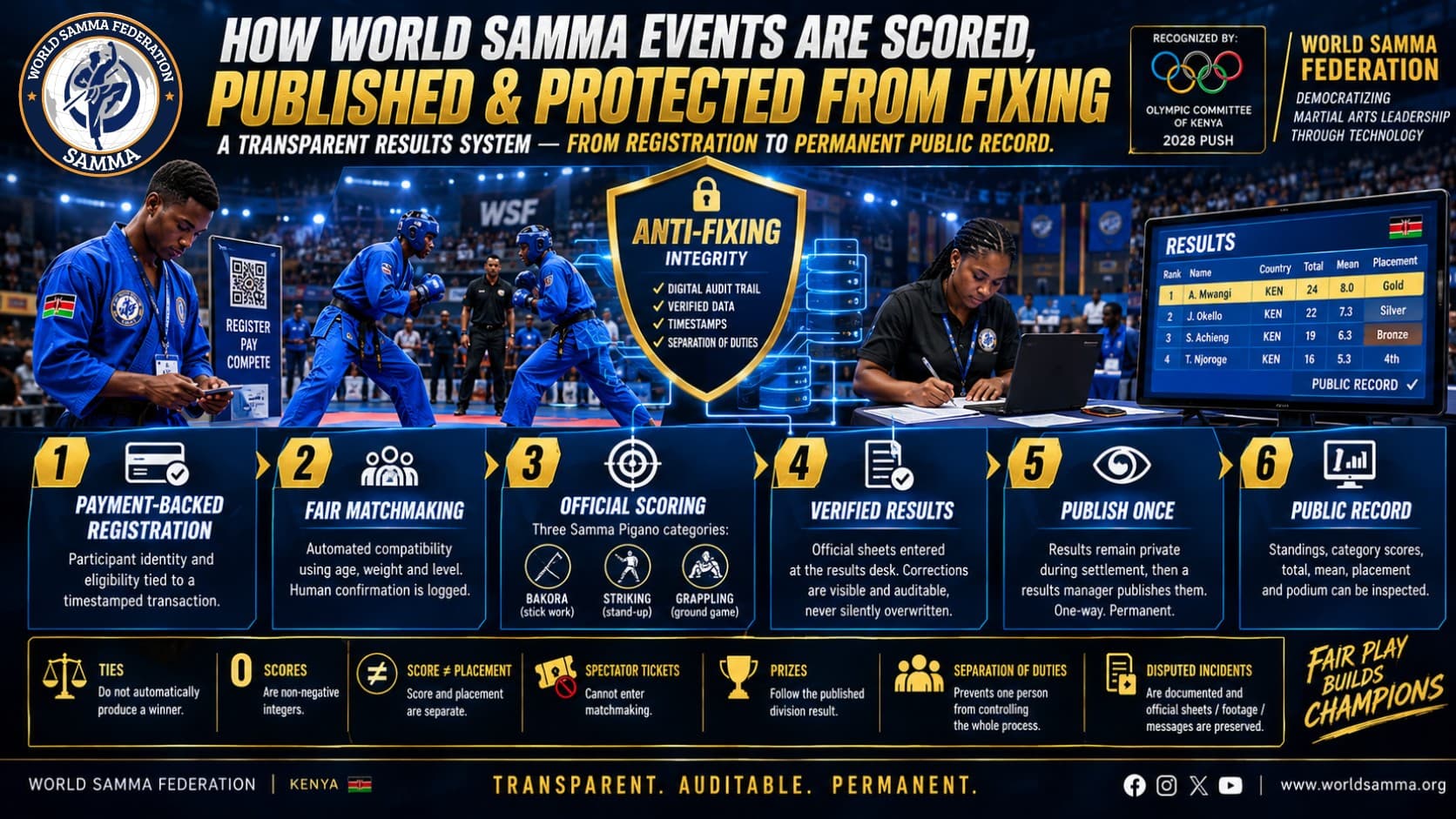
Participant registration is not a form someone fills in on the day. A competitor is a ticket order — a payment-backed record carrying full name, date of birth, height, weight, level, gender and age category, team or club, and special-needs flag. Every entry on a start list traces back to a specific order with a specific payment reference and a specific timestamp.
This matters more than it sounds. A result is only meaningful if the identity behind it is fixed. In Samma, nobody is entered by a coach's word, a clipboard, or a phone call. They are entered by a transaction, and that transaction is dated.
Eligibility is a hard gate, not a judgement call
Checkout refuses registration when the event is unpublished, when registration is closed, when the deadline has passed, or when a ticket type is inactive or out of stock. Those four checks are server-side. There is no path where a closed registration silently accepts one more fighter "just this once."
Only participants compete
Matchmaking reads from participant-category entries. Spectator and add-on holders never appear in a pairing. A paying spectator cannot be inserted into a draw because a phone was handed to the wrong person at the desk.
2. Matchmaking Is an Engine, Not a Decision
The platform computes compatibility rather than asking a human to eyeball a list. Every possible pairing is scored on three axes:
- Age gap under a year costs nothing; each widening band costs more, and a wide gap is disqualifyingly expensive
- Weight gap uses the same banded structure, so size mismatches naturally sort themselves out
- Level match Novice against Advanced is treated as a mismatch, full stop
The engine then sorts by weight and pairs adjacent entries. Auto-match produces a proposal, never a decision. An organizer confirms it. That confirmation is the accountability seam: the machine suggested, a named human with results authority accepted, and that acceptance is a logged act.
The intent is simple. Nobody should ever be handed a First Amendment to an unsanctioned fight. Size and experience are recorded for matchmaking, and the whole structure exists so that a novice is not quietly entered into a fight they could lose badly.
3. Scoring: What a Score Actually Is
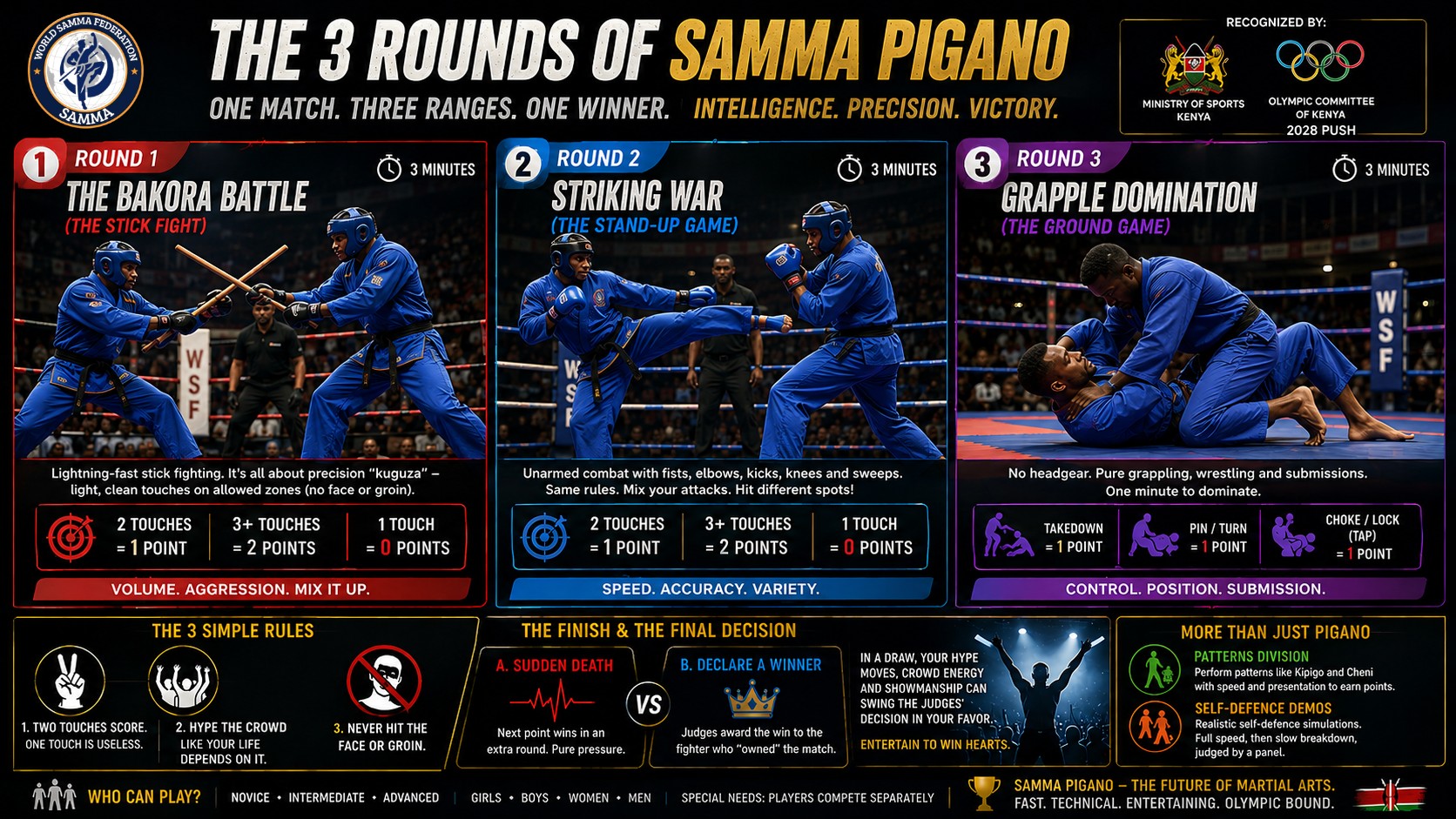
Samma Pigano is three minutes across three phases, and results are recorded in the three categories the sport actually scores:
| Category | What it captures |
|---|---|
| Striking | Round 2 stand-up - clean touches, kicks, punches, elbows, knees, sweeps |
| Unarmed | Round 1 bakora work - touches scored on the stick; two to a point, one is nothing |
| Grappling | Round 3 ground - takedown, pin or turn, submission tap |
These three sum to a total score. A mean score is derived from the non-zero categories, and a placement is assigned from 1 upward.
Three rules govern the arithmetic, and they are non-negotiable:
- A tie produces no winner. Identical totals yield
winner = null. The system will not break a tie for an organizer who wants it broken. Ties are escalated to a decision procedure with a named authority, not resolved by whoever is nearest the desk. - Scores are non-negative integers. No negative adjustments, no discretionary deductions smuggled in through a score field.
- Placement and score are separate fields. A placement is a stated conclusion. It is recorded as a conclusion, and the score that produced it stays visible underneath it. A placement with no score behind it is a gap in the record, and gaps are investigated.
4. The Parts of the Job Most People Skip
The hard part of running a results desk is not typing numbers. It is the boring discipline around them.
Do not enter scores from memory or from a phone screen held across the ring. Enter from the judges' official record, at the results desk, with the match in front of you. If the match has finished but you do not have the official sheet, the correct action is to wait, not to reconstruct.
One match, one result, one entrant. A result row is created once. If you make a mistake, you do not overwrite it and move on; you correct it through the record while it is still within the authority window, and the sequence of edits is what an audit is built on.
Never delete a result to clear a mistake. Deletion is a governance action, not a convenience. It is reserved for rows that were never valid. If a score is wrong, the fix is a visible correction.
Closing a bout is separate from scoring it. Marking a match completed is a distinct act from entering a result. Two steps, two moments, two chances to pause and think.
5. Results Are Private Until a Manager Publishes Them
This is the single most important control in the system, and it is already running on every event.
Nothing is public until a results manager publishes it. Results entered during a live event are invisible to competitors, spectators, and the wider public. The only surface that shows a score is the one behind the publish action.
That gives you three things:
- A settlement window. Scores are entered, checked against the official sheets, and reconciled while the event is still live and the people who were there are available to correct a mistake.
- A clean public record. The public never sees a number change, move, or vanish. What appears on the published results page is the record as it stood at the moment of publication.
- Publishing is one-way. Once results are published for an event, the publish action does not run again. The UI will refuse a second publish, and that refusal is a feature, not a limitation.
After publication, the results page for the event is permanent: standings, per-category breakdown, total score, mean score, placement, and the podium. It is a public artifact of a settled competition.
6. Match Fixing: The Policy, and What Enforces It
Match fixing is a career-ending offence. Not a fine, not a suspension that expires, not a private word with a director. It ends the person, and it taints the result.
The policy applies to everyone holding any position of influence in an event: results managers, division leads, coaches, judges' clerks, ticket desk staff, and organizers.
What counts as fixing
- Entering, altering, or omitting a score to produce a preferred outcome
- Changing a placement to move a competitor up or hold a competitor down
- Trading money, entry fee, future placement, or favour for a result
- Communicating a desired outcome to a competitor before a match
- Advising a competitor how to win a bout they are not assigned to
- Using another event's position, access, or information to benefit a competitor
- Suppressing a legitimate result because the outcome was "not the story we wanted"
What the controls do
| Control | What it prevents |
|---|---|
| Payment-backed, timestamped registration | Competitor identity and eligibility being retrofitted after the fact |
| Server-side eligibility gates | Late or ineligible entries being slipped in through the desk |
| Automated compatibility matchmaking | Bouts built to suit a result rather than a division |
| Engine-proposed, human-confirmed pairings | Pairings quietly chosen for outcome rather than equity |
Ties resolving to null |
An organizer being handed a convenient winner |
| Separate score and placement fields | A conclusion being presented as arithmetic |
| Private-until-published results | Scores being observed, adjusted, or exploited in real time |
| One-way, single-use publishing | A settled public record being quietly edited later |
| Non-negative validated scoring | Scores used as a channel for discretionary deduction |
How a concern is handled
- Raise it immediately with the WSF, through the event contact channel, in writing.
- Do not circulate allegations in public posts, group chats, or on event day.
- Preserve everything — screenshots, messages, sheets, photos. Do not delete a message you sent or received.
- The WSF may suspend the results of an affected event pending review. Suspension is not a finding; it is the safe default.
- Findings are published. A confirmed fixing offence results in permanent removal from the sport, a public statement naming the offence and the event, and a review of every result that person's authority touched — not just the bout they were suspected of.
The one line organizers need to remember
Never tell a competitor how a bout will be scored. You do not know that. Nobody does, until the sheets are in and the results are published. Advising a competitor toward an outcome is fixing, whether or not you intended it that way, and the fact that it was well-meant is not a defence.
7. Prizes Follow the Division, Not the Favour
Prizes are structured objects, not goodwill. Each prize at an event is defined by:
- Placement — 1st, 2nd, 3rd
- Type — money, trophy, qualification, or other
- Amount and currency
- Scope — championship level, age category, gender category, special needs, and whether it is a team prize
That scoping is the governance point. A prize belongs to a division. A team prize belongs to a team. A special-needs prize belongs to the special-needs bracket. A prize is awarded to the entity the prize was written for, determined by the published result, not by who the organizers would prefer to see on a podium.
Qualification prizes are the sharpest edge. A qualification slot is a claim on something larger, and a slot moved to the wrong competitor is a whole career affected. Treat qualification prizes as the most serious objects on the sheet, because they are.
If a prize on your event page is ambiguous, fix the ambiguity before results are published, not after a complaint.
8. Separation of Duties — Who Should Be Doing What
Conflicts of interest are the quiet version of fixing, and they are more common than deliberate corruption. Organize so that no single person holds all of it.
| Function | Should be | Should not be |
|---|---|---|
| Entering scores | A results clerk at the desk, from the official sheet | The competitor's coach, or anyone with a stake in the outcome |
| Confirming pairings | The division lead or matchmaker | The competitor's own coach, in any division |
| Assigning placement | Derived from the entered score | Hand-typed to produce an outcome |
| Publishing results | A results manager | Someone who stood in the ring of interest, informally |
| Awarding prizes | Verified against the published result | Verified against a paper list kept off-platform |
If you are a club coach running your own club's event, be honest with yourself about the position you are in. You are the single most likely person to be asked to favour your own athlete. Say so in advance, put another name on the scoring desk, and let it be on the record.
9. When Something Goes Wrong
Things go wrong at events. Judges leave. A fighter is injured. A bout is disputed. A result is entered against the wrong competitor. The score is misread. The discipline is in the response, and the response should never be to make the record disappear.
Standard incident sequence:
- Stop. Do not enter a result while the situation is unresolved.
- Record what happened, in writing, with the time.
- Notify the WSF through the event contact channel.
- Preserve the official sheets, footage, and messages.
- Await direction. For a disputed bout, the WSF may direct a re-score from the official sheet, a bout annulment, or a result suspension. An organizer may not unilaterally re-score a bout that has already been decided.
Injuries and medical suspensions are not disputed results. They are recorded, reported, and honoured. A fighter who cannot continue is withdrawn, not scored as a loss they didn't take.
10. Results, Live, Are the Product
The public results page exists because the sport decided that its record should be inspectable. Any competitor, parent, club, or someone with no connection to the event at all can open any published event and read the standings, the per-category scores, the total, the mean, the placements, and the podium.
That visibility is the point. A result you can check is a result people believe. A result nobody can check is a rumour with a trophy.
The events are running now. The scores are going in. And the record that comes out the other side will be exactly the record entered on the night by a named person, in front of the people who were there.
Organizing an event? Membership in a recognized association is required — see the FAQ and Contact.